
No products in the cart.
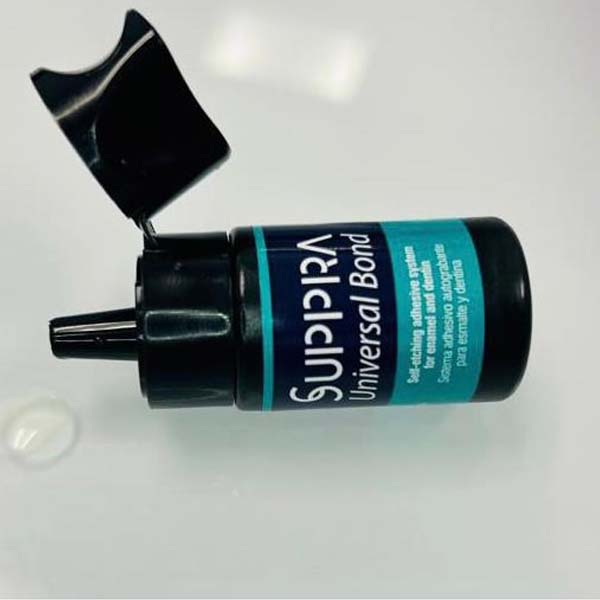
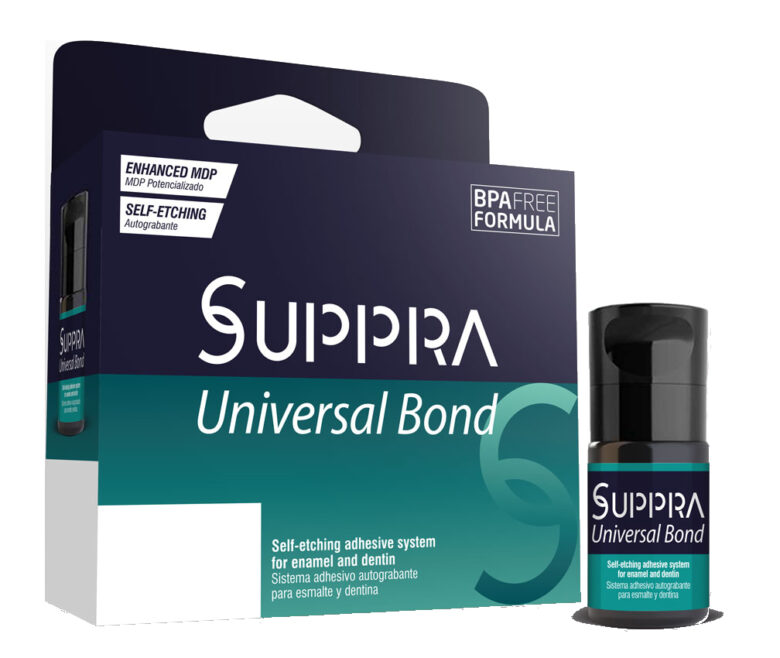
SUPPRA UNIVERSAL BOND
SUPPRA Universal is a light-cure, Self-etch adhesive system , 5ml Bottle. for enamel and dentin. Excellent performance at any moisture level of dentin. Perfect for intracanal application. BPA Free. And can also be used as a primer for metal and ceramic restorations. with enhanced MDP
Availability: 999
SUPPRA Universal Bond , Self-etch adhesive system for enamel and dentin
SUPPRA Universal Bond is a single bottle self-etch lightcuring adhesive system (seventh generation) responsible for the union between tooth structure (enamel and dentin) and restorative materials. The primer and bonding agent are combined in a single bottle. Prior use of acid etchant is optional on both enamel and dentin, it can be used, therefore, in three protocols: self-etch,
selective-etch and total-etch.
It can be used for direct restorations made of composite resins and light-curing glass ionomer or for indirect procedures when associated with resin cement. SUPPRA Universal Bond contains MDP, which allows it to be used as a metallic and ceramic primer. The product contains a system of advanced polymerization and consists of a combination of different photoinitiators that interact among each other amplifying the curing capacity of light emitted from light-curing units. Added to different materials, the system provides different advantages. When incorporated to Suppra Universal Bond’s composition, it increases the conversion degree in the hybrid layer, which enhances the adhesive ́s bond strength and increases mechanical properties of the adhesive film (greater cohesive strength). The product is colorless, which provides a remarkable visual advantage when compared to other adhesive systems. This avoids any type of interference when performing a restoration/ cementation on anterior teeth.
Product Presentation
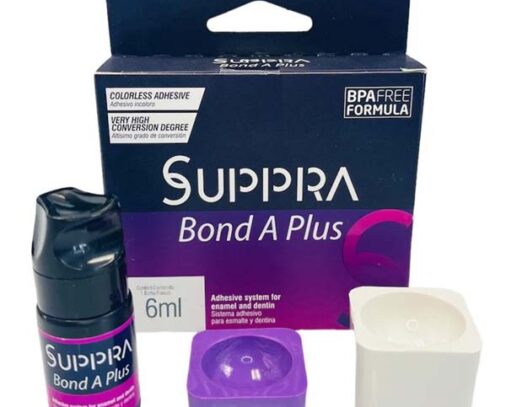
1 bottle with 5 ml of product. and dual Dappen Dish
Basic Composition
Active ingredients: MDP (10-Methacryloyloxydecyl Dihydrogen Phosphate), Methacrylate Monomers, photoinitiators complex, co-initiators, stabilizers.
Inactive ingredients: inert load (Silica particles) and Vehicle (Ethanol).
Product indication
· All classes of direct restoration with composites (class I, II, III, IV and V).
· Adhesive luting (in addition to resin cement) of prosthetic pieces (post/cores, crowns, onlays/inlays, veneers, etc.) made of fiberglass, ceromer, ceramic, resin and metal.
· Adhesive repairs in ceramic and composites.
· Use as metallic or ceramic primer.
Precautions and contraindications
1. Before using the bonding agent, make sure that the dentin surface is slightly shiny (moistened), but not wet.
2. The air used in the whole procedure must be oil and water free.
3. The recommended light-curing time for this product depends on the power of the light emitted by the equipment used. The recommended power intensity of the light-curing unit is above 450mW/cm2 which guarantees the quality of the Polymer generated and the quality of the bonding. Light-curing units must have its light intensity checked by radiometer frequently. It is recommended that the patient and the surgeon use protective goggles during the emission of blue light by the light-curing unit.
4. Do not apply excess of adhesive to avoid compromising the quality of adhesion and prevent any aesthetic and functional problems. Excessive application of air blasts should also be avoided to prevent air bubbles in the adhesive.
5. Do not leave the adhesive at the reach of patients and children.
6. The adhesive contains Methacrylate Monomers. Avoid using the product in patients with allergy to Acrylates/ Methacrylates. To reduce risks, minimize the exposure time of the dental tissues to the material when it is not polymerized.
7. Wear protective gloves when handling the product. If the product comes into accidental contact with eyes or oral tissues, wash the area abundantly with water.
8. Make sure closing the bottle lid after use.
9. Protect the dentin-pulp complex with a base or liner material in deep cavities. Do not use material that contains Eugenol as a basis to avoid insufficient curing on the surface. The application of high concentration of H2 O2 should also be avoided because it can interfere on the curing process of the adhesive.
10. There is no need shaking the bottle before using the adhesive.
Side effects
The adhesive can cause alergic reactions in patients who are sensitive to any components of the formula. In this case, the material should not be used.Instructions for use
Before starting the treatment read carefully the warnings, precautions, contraindications and possible side effects.
1.1 Light-curing direct restorations in enamel and/or dentin:
A. Perform prophylaxis of the teeth with pumice and water or with Sodium Bicarbonate jet.
B. Prior to taking the teeth shade make sure that teeth are clean and hydrated.
C. Anesthesia can be administered if required.
D. Properly isolate the area: direct bonding restorations can be adequately performed with rubber dam or relative isolation depending on the case. There are cases where the use of rubber dam is essential.
E. Tooth preparation: prepare the cavity with minimal reduction of tooth structure as possible.
F. Adhesive application: see specific procedure of number 2 and 3 of this manual.
1.2 Instructions for bonding of indirect restorations:
A. Tooth preparation: isolate the tooth with rubber dam or relative isolation and use a gingival retraction cord when the margin of the preparation is subgingival, to not
contaminate during tooth preparation.
B. Properly clean the preparations with pumice and prophylaxis brush / cup.
C. The treatment of the inner surface of the prosthetic parts should follow recommendations according to the classification of the material. Follow the manufacturer’s recommendations on the cementation process.
D. Adhesive application: see specific procedure of number 3 of this manual.
1.3 Instructions for bonding of prefabricated posts:
A. Perform a radiographic examination (periapical radiographs) and check the quality of the endodontic
treatment.
B. Isolate the operative field. Prioritize the use of rubber dam.
C. Partially remove the gutta-percha from the root canal using a specific drill or appropriate instrument maintaining 3 to 5 mm of gutta-percha in the apical region, ensuring the sealing of endodontic fillings.
D. Select the prefabricated post according to the diameter of the root canal.
E. Prepare the root canal with appropriate drill to adapt it to the post shape. Avoid unnecessary removal of tooth structure. For post colocation, use drills according to the diameter of the selected post.
F. Adhesive application: See specific procedure of number 2 and 3 of this manual.
2. Preparation of dental substrate
2.1 Self-etch method
A. Direct and Indirect restorations: there is no need for enamel/dentin prior etching.
B. Prefabricated posts bonding: there is no need for prior etching of enamel/dentin.
2.2 Enamel selective-etch method
A. Direct and indirect restorations: apply Phosphoric Acid 37% only on enamel for 15 seconds. Wash the surface with water and dry the cavity until it is moist, not dehydrated.
B. Luting of prefabricated posts: there is no need for prior etching of dentin.
2.3 Total-etch method
A. Direct and indirect restorations: apply Phosphoric Acid 37% for 15 seconds on both enamel and dentin, according to the type of preparation. Wash the surface with water and dry the cavity so the dentin does not dehydrate but avoid accumulation of water on the surface. If rewetting the dentin for the application of the adhesive system is necessary, use cotton, pellets moistened with distilled water or Chlorhexidine 2%. By rewetting the dentin the enamel is also rewetted, which can be treated by using the moist technique.
B. Cementation of prefabricated post: apply Phosphoric Acid gel 37% into the root canal and remaining tooth structure for 15 seconds. Wash the area carefully and remove the excess water with absorbent paper cones.
3. Adhesive application
3.1 Direct and indirect restorations: dispense SUPPRA Universal Bond in a dappen pot or directly onto a disposable micro applicator. Apply two layers of adhesive – one drop for each- on the slightly moistened tooth surface. The first layer should be applied vigorously by rubbing the adhesive microapplicator saturated with the product for 10 seconds. Next, the second layer of adhesive – with a new drop – is applied for another 10 seconds and then the area is air blasted gently for 10 seconds to evaporate the solvent. Light cure Suppra Universal Bond with blue light for 10 seconds.
3.2 Cementation of prefabricated posts: With the aid of a disposable micro applicator, apply two layers – one drop for each of the product into the root canal vigorously rubbing the adhesive on the walls of the conduit for 10 seconds. Evaporate the solvent with gentle blasts of oil-free air for 10 seconds, and then light cure it for 20 seconds.
OBS: During the adhesive application for post cementation, avoid accumulation of the product in the apical region. Excess of adhesive in this region compromises the evaporation of the solvent and polymerization.
3.3 As metallic or non-etchable ceramics primer: After sandblasting the internal surface of the prosthetic pieces, wash and air dry it. With the aid of a disposable micro applicator, apply Suppra Universal Bond under friction on the internal surface of the previously treated piece, leave it undisturbed for 15 seconds and then apply gentle air for 10 seconds. Do not light cure, then apply the resin cement on the internal surface of the piece.
3.4 As etchable ceramics primer: The application method of SUPPRA Universal Bond is equivalent to that indicated of number 3.3, however, instead of sandblasting the surface, it must be Acid etched with Fluoridric Acid and receive Silane agent before SUPPRA Universal Bond application. For further instructions on how to apply the Acid and Silane please refer to the respective instruction manuals. The recommended cure time for this product depends on the power of the light emitted by the equipment used. The recommended power density of the light-curing unit is above 450mW/cm2 , which guarantees the quality of the Polymer generated and also the quality of the bonding.
4. Bonding of restorative materials
Perform restoration or cementation according to specific instructions of the product selected for the (composite resins and/or cements).
Conservation and storage
· Suppra Universal Bond must be stored in temperatures between 5 oC to 25 oC / 41 oF – 77 oF.
· Protect product from external contamination.
· The bottle containing the product must be closed carefully after use in order to prevent solvent evaporation.
· Do not expose the product to intense light or hightemperatures.
· Do not use the product after expiration date.
· For cleaning remains of Suppra Universal Bond alcohol can be used.
· Suppra Universal Bond expires 2 years after the date of manufacture which is indicated on the box of the product.
Warnings
· Do not reuse the empty package.
· Do not use the product after expiry date. In order to discard the product, follow the legislation of your country.
· Keep out of reach of children.
This material was only manufactured for dental use and must be handled according to the instructions for use.
The manufacturer is not responsible for damage caused by other uses or incorrect handling. Besides this, the user is obliged to verify, before use and under his or her responsibility that this material is compatible with the use desired, mainly when this use is not indicated in the instructions for use.
Data descriptions do not constitute any type of guarantee and so are not in any way linked.
Physical properties
Light intensity for curing > 450mW/cm2
Wavelength for curing 400-500 nm
Length of cure 10” Direct and indirect restorations
20” Cementation of prefabricated posts
| Weight | .2 lbs |
|---|---|
| Dimensions | 1 × 4 × 4 in |


Reviews
There are no reviews yet.